
Entry Technologies
Design & Digital Technologies
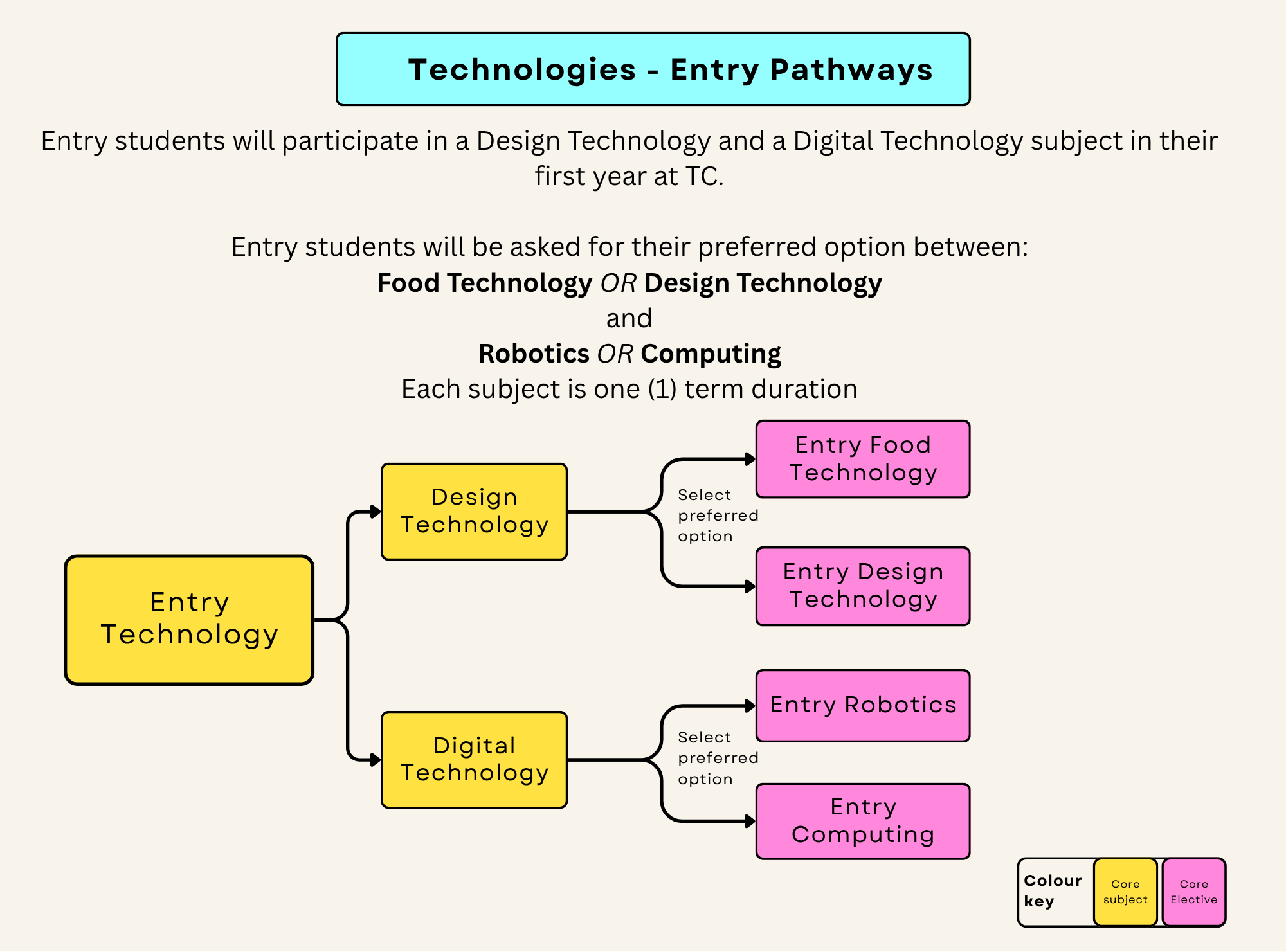
Students complete one Design Technology subject and one Digital Technology subject, each running for one term. Design Technology subjects are Food Technology and Design Technology. Digital Technology subjects are Robotics and Computing. Across all four subjects, students follow the TC Design Process, a common approach to identifying problems, generating ideas, and creating, testing and refining solutions.
Food Technology
Students develop the fundamental knowledge and practical skills needed to work safely and confidently in a kitchen. This subject focuses on food safety and hygiene, including safe food handling, preventing cross-contamination, and maintaining a clean workspace. Students also learn and practise essential knife skills, using a range of techniques to prepare ingredients safely and efficiently. Through practical cooking activities, students build confidence while developing independence, teamwork, and an understanding of safe and responsible food preparation and design practices.
Design Technology
Students develop foundational design and making skills, learning to work safely and confidently with both traditional workshop tools and digital fabrication technologies such as CAD, 3D printing and laser cutting. Students follow the TC Design Process to investigate a real-world problem, generate and test ideas, and create a solution, while learning correct and safe use of hand and machine tools. Through hands-on making, students build confidence, resilience and problem-solving skills, and develop an understanding of how good design meets the needs of users.
Robotics
Students are introduced to the fundamentals of robotics using the VEX platform, learning to design, build and program robots to complete set challenges. Students develop skills in mechanical construction, sensors and coding logic, while following the TC Design Process to plan, test and refine their solutions. Through collaborative, hands-on challenges, students build teamwork, perseverance and computational thinking skills, and develop confidence in applying engineering and programming concepts to solve practical problems.
Computing
Students build foundational digital literacy and computational thinking skills, learning core concepts in coding, data and digital systems. Students follow the TC Design Process to define problems, design algorithms, and develop simple programs and digital solutions, while learning to use software and hardware safely and responsibly. Through practical, project-based tasks, students build confidence, creativity and problem-solving skills, and develop an understanding of how computing technologies shape the world around them.